

Publishing more content doesn’t automatically lead to better rankings. Many businesses invest significant time creating blog posts and service pages, yet still struggle to attract qualified traffic because their content isn’t aligned with user search intent or Google’s expectations for helpful, authoritative information.
Content SEO focuses on creating, improving and maintaining website content so that it satisfies user needs while helping search engines understand its relevance. It combines strategic planning, keyword research, semantic optimisation, internal linking and topical authority to build content that performs over the long term.
As an SEO consultant, I’ve worked with businesses across the UK, India and Dubai, and one of the most common problems I encounter is content written primarily for keywords rather than people. While keywords remain important, modern SEO is driven by understanding user intent, answering real questions and creating content that genuinely helps visitors make informed decisions.
My content seo services are designed to improve existing content as well as develop new content strategies that increase search visibility, strengthen topical authority and support sustainable business growth. Whether you’re a local business, trades company, B2B organisation or service provider, well-optimised content creates stronger opportunities to attract qualified visitors and convert them into customers.
In this guide, I’ll explain what Content SEO services include, why they matter and how I optimise content to help businesses achieve long-term organic growth.
What Are Content SEO Services?
Content SEO services improve the quality, relevance and structure of website content to help it rank higher in search results, satisfy user search intent and encourage meaningful engagement. Rather than simply producing more content, Content SEO ensures every page contributes to your website’s overall topical authority and business objectives.
Many people assume Content SEO simply means writing blog articles with keywords. In reality, it involves developing a complete content strategy that aligns every page with what users are searching for while making it easier for search engines to understand how different topics relate to one another.
Professional Content SEO typically includes:
- Content audits
- Search intent analysis
- Keyword and topic research
- Content optimisation
- Internal linking
- Content refresh strategies
- Topic cluster development
- Semantic SEO
- Performance monitoring
Google’s Search Essentials encourage website owners to create helpful, reliable and people-first content rather than writing purely for search engines. This means every article, service page and landing page should provide genuine value, answer user questions and demonstrate expertise.
Instead of publishing large volumes of content, I focus on improving the quality and relevance of every page. This approach helps businesses build long-term authority while creating a better experience for both users and search engines.
Content SEO vs SEO Copywriting
Although these terms are often used interchangeably, they serve different purposes.
| Content SEO | SEO Copywriting |
|---|---|
| Focuses on long-term search performance | Focuses on writing persuasive copy |
| Builds topical authority | Encourages users to take action |
| Includes optimisation, planning and analysis | Primarily focuses on written content |
| Improves existing content | Creates new marketing copy |
| Supports the entire website | Usually focuses on individual pages |
SEO copywriting is one element of Content SEO, but successful content strategies involve much more than writing. They require planning, optimisation, internal linking and ongoing improvement to remain competitive.
Content SEO vs On-Page SEO Services
Content SEO and on-page seo services work closely together, but they focus on different aspects of optimisation.
Content SEO is concerned with the quality, relevance and overall strategy behind your website’s content. It helps determine what topics you should cover, how pages should support one another and how your content satisfies search intent.
On-page SEO focuses on optimising the elements within individual pages, including title tags, meta descriptions, headings, image optimisation and internal links.
I often explain it this way:
- Content SEO decides what your website should say.
- On-page SEO determines how each page should be presented to search engines and users.
When combined, they create a strong foundation for sustainable organic growth.
Why Content SEO Matters for Long-Term Organic Growth
Content SEO helps businesses create content that attracts the right audience, answers important questions and builds long-term visibility in search engines. Instead of chasing rankings for individual keywords, it develops a connected knowledge base that supports topical authority and sustainable business growth.
Many businesses publish articles regularly but fail to see meaningful results because every page exists in isolation. Without a clear content strategy, internal linking structure and search intent alignment, even well-written articles struggle to compete.
Effective Content SEO helps businesses:
- Improve organic visibility.
- Build trust and authority.
- Increase qualified website traffic.
- Strengthen user engagement.
- Improve internal linking.
- Support lead generation.
- Future-proof content for AI-powered search.
Rather than measuring success by the number of published articles, I focus on whether each page contributes to your wider SEO strategy and delivers measurable business value.
Understanding Search Intent
One of the biggest shifts in modern SEO is moving away from keyword-first optimisation towards intent-first optimisation.
Instead of asking:
“Which keyword should I target?“
I ask:
“What information is the user expecting when they search?“
Understanding search intent helps determine:
- The depth of content required.
- The questions that should be answered.
- The type of media that supports the page.
- The most appropriate calls to action.
- How the page connects to the wider website.
Content that satisfies search intent is more likely to engage readers, encourage longer sessions and perform well in search results.
Businesses comparing seo vs ppc often discover that high-quality, intent-focused content benefits both channels. Well-optimised landing pages improve organic visibility while also increasing the relevance, engagement and conversion rates of paid advertising campaigns, helping businesses maximise their overall digital marketing investment.
How Content Builds Topical Authority
Search engines increasingly reward websites that demonstrate expertise across an entire subject rather than publishing isolated articles.
This is where topic clusters become important.
Rather than creating unrelated blog posts, I organise content into connected themes that support one another through strategic internal linking.
For example, a business looking for an SEO agency in Portsmouth may first read articles about Content SEO, Technical SEO or Local SEO before deciding to make an enquiry. By connecting these related topics, your website becomes a more comprehensive resource while helping search engines understand your expertise.
This strategy also strengthens pages such as technical seo services, allowing authority to flow naturally throughout your website instead of remaining concentrated on a single page.
Content clusters create a better experience for readers because they make it easier to explore related topics and continue learning without returning to search results.
What's Included in Professional Content SEO Services?
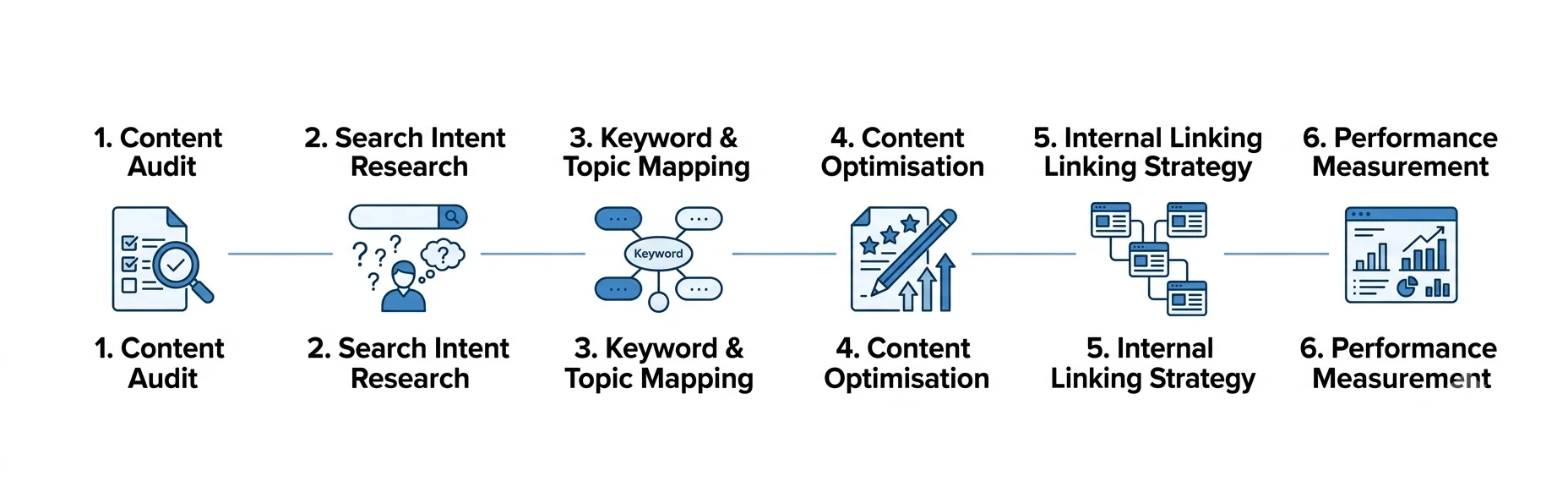
Professional Content SEO services optimise every stage of your content strategy, from planning and auditing to optimisation and ongoing improvement. The goal is to create content that satisfies user search intent, strengthens topical authority and contributes to long-term organic growth rather than simply increasing the number of published pages.
Every website has different goals, audiences and levels of competition. That’s why I don’t follow a generic checklist. Instead, I develop a strategy that reflects your business objectives, identifies opportunities for improvement and prioritises the actions most likely to increase visibility and engagement.
Content Audit
Before creating new content, I assess the quality and performance of your existing pages.
A Content SEO audit typically includes:
- Search intent alignment
- Organic traffic analysis
- Keyword relevance
- Content depth
- Duplicate content
- Thin or outdated pages
- Internal linking opportunities
- User engagement metrics
- Content gaps
- Opportunities to consolidate overlapping pages
In many cases, improving existing content delivers better results than publishing additional articles.
Keyword Research & Topic Mapping
Effective Content SEO starts with understanding how your audience searches.
Rather than selecting isolated keywords, I group related topics into logical clusters that support broader business goals.
This process includes:
- Primary keyword research
- Supporting keyword identification
- Semantic keyword analysis
- Search intent mapping
- Entity research
- Competitor analysis
- Topic clustering
A structured content plan helps search engines understand the relationship between your pages while making it easier for users to explore related topics.
Content Optimisation
Content should do more than rank—it should help users achieve their goals.
When optimising content, I review:
- Search intent
- Content quality
- Readability
- Heading hierarchy
- Semantic relevance
- Internal linking
- Calls to action
- E-E-A-T signals
Instead of rewriting pages unnecessarily, I focus on improving clarity, completeness and relevance while preserving valuable information already present.
My recommendations follow Google’s guidance published through Google Search Central, helping ensure content remains aligned with current best practices.
Internal Linking Strategy
Internal links play a crucial role in helping both users and search engines navigate your website.
I review opportunities to:
- Connect related pages.
- Improve crawlability.
- Strengthen topical authority.
- Distribute page authority naturally.
- Guide visitors through their buying journey.
A well-planned internal linking strategy also supports link building for local businesses, as valuable content is more likely to attract natural backlinks and encourage visitors to explore additional resources.
Content Refresh Strategy
Publishing new content is only part of the process.
As search behaviour changes, existing pages often need updating to remain relevant.
A content refresh may involve:
- Updating statistics.
- Adding new examples.
- Improving search intent alignment.
- Expanding weak sections.
- Improving internal links.
- Removing outdated information.
- Refreshing metadata.
Regular updates help maintain rankings while ensuring content continues to provide value.
Performance Measurement
Content should be measured against meaningful business objectives rather than rankings alone.
I monitor:
- Organic traffic
- Keyword visibility
- Click-through rate
- User engagement
- Conversion performance
- Internal link engagement
- Search Console performance
Using tools such as Google Search Console, Google Analytics 4, Ahrefs and SEMrush allows me to identify what’s working and where further optimisation is needed.
The Most Common Content SEO Mistakes I Find
One of the biggest Content SEO mistakes businesses make is creating content simply because they’ve found a keyword with search volume. Successful content starts with understanding what users actually want to achieve when they search.
During content audits, I regularly identify the same issues regardless of industry.
The most common include:
- Writing primarily for keywords instead of users.
- Poor search intent alignment.
- Thin or low-value content.
- Duplicate content.
- Weak internal linking.
- Outdated information.
- Publishing isolated articles without topic clusters.
- Missing calls to action.
- Inconsistent heading structures.
These problems make it difficult for search engines to understand how content relates across the website and reduce the overall value provided to users.
Many of these issues can be prevented by avoiding common seo mistakes and reviewing content regularly instead of only producing new pages.
How I Prioritise Content Improvements
Rather than making random edits, I prioritise changes based on potential business impact.
| Priority | Focus |
|---|---|
| High | Search intent, content quality and topical relevance |
| Medium | Internal linking, semantic optimisation and content depth |
| Lower | Formatting improvements and minor refinements |
This approach ensures resources are focused on improvements that are most likely to increase visibility and engagement.
How Content SEO Supports Local SEO
Strong local SEO depends on more than location pages. High-quality, locally relevant content helps businesses demonstrate expertise, answer customer questions and strengthen their relevance for local searches.
Businesses investing in local seo portsmouth often focus on optimising Google Business Profiles while overlooking the content on their own websites.
Creating helpful service pages, location guides and educational resources provides stronger landing pages for local searchers and increases opportunities to appear for a wider range of relevant searches.
Content also complements google business profile optimisation portsmouth, helping users find detailed information after discovering your business in local search results.
For businesses offering specialist services, particularly seo for trades businesses, location-specific content can significantly improve visibility and encourage more qualified enquiries.
Content SEO for AI Search
As search continues to evolve, Content SEO plays an increasingly important role in helping AI-powered search systems understand, retrieve and reference your content.
Google AI Overviews, ChatGPT, Gemini and Perplexity all favour content that is:
- Helpful.
- Well structured.
- Easy to understand.
- Factually accurate.
- Rich in context.
That’s why my Content SEO approach focuses on semantic relationships, answer-first writing, logical heading structures and topical completeness.
These principles also support generative engine optimisation, helping businesses prepare their websites for the next generation of search experiences.
How Much Do Content SEO Services Cost?
The cost of Content SEO varies depending on the size of your website, the number of pages requiring optimisation and the depth of improvements needed.
Some businesses only require content audits and optimisation, while others benefit from complete content strategies, topic cluster development and ongoing performance reviews.
If you’re comparing pricing, my guide to seo cost portsmouth explains the factors that influence SEO investment and how to evaluate the value of professional SEO services.
Rather than focusing on the lowest price, I encourage businesses to consider the long-term return that strategic Content SEO can deliver.
Why Work With Me?
Content SEO isn’t just about writing better articles. It’s about understanding how people search, how search engines interpret information and how every page contributes to your website’s overall authority.
I’ve worked with businesses across the UK, India and Dubai, helping improve organic performance through content strategy, search intent optimisation and technical best practices.
When optimising content, I combine insights from:
- Google Search Console
- Google Analytics 4
- Ahrefs
- SEMrush
- Screaming Frog
- Yoast SEO
- Rank Math
This allows me to make informed decisions based on data rather than assumptions.
If you’re looking for an experienced SEO agency in Portsmouth, I believe the best SEO strategies are built around understanding your business, your audience and your long-term goals rather than relying on one-size-fits-all templates.
Content SEO services improve website content by aligning it with search intent, semantic relevance and user needs, helping pages achieve better visibility and engagement.
Yes. In many cases, improving existing content through better structure, updated information and stronger internal linking is more effective than creating new pages.
I recommend reviewing important pages every six to twelve months or whenever rankings decline, user behaviour changes or new competitors emerge.
SEO copywriting focuses on creating persuasive written content, while Content SEO covers the wider strategy, including planning, optimisation, internal linking and ongoing performance improvement.
Yes. By aligning content with user intent and making information easier to understand, Content SEO can improve engagement and encourage more visitors to take action.
Ready to Improve Your Website's Content SEO?
Your website’s content should do more than fill pages—it should answer important questions, build trust and support your business goals.
Effective Content SEO isn’t about producing the highest number of articles. It’s about creating the right content, for the right audience, at the right stage of their journey. By improving search intent, strengthening topical authority and optimising existing pages, businesses can build sustainable organic growth that continues to deliver value over time.
Whether you’re a local business, B2B company or growing service provider, strategic content seo services can help improve rankings, attract more qualified visitors and increase meaningful enquiries.
If you’re unsure whether your current content is performing as well as it could, I’d be happy to carry out a comprehensive Content SEO audit. I will explain the findings in simple English, prioritise recommendations based on business impact and provide a practical roadmap for improving your website’s content strategy and long-term organic performance.