
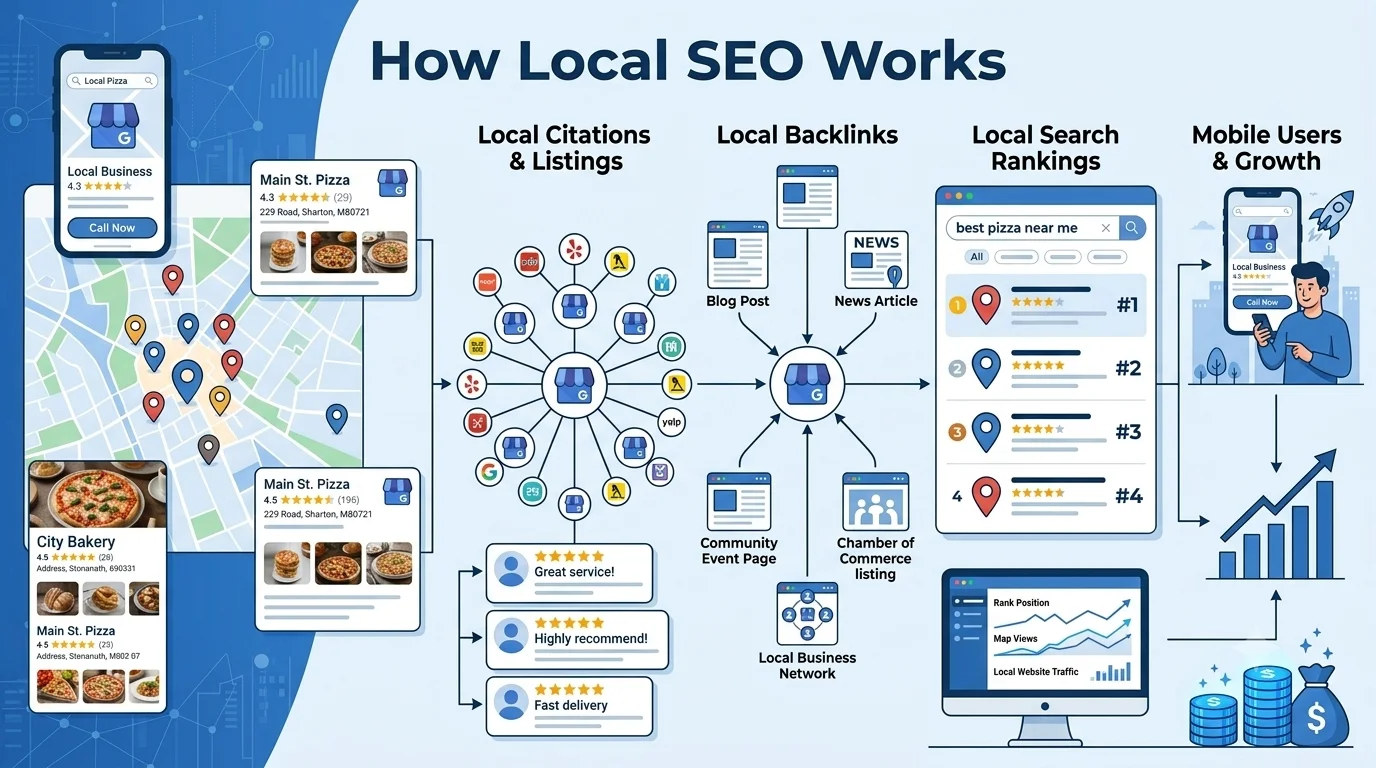
When people search for a product or service near them, Google aims to show the most relevant and trustworthy businesses in the area. This process is powered by local SEO.
Local SEO helps businesses improve their visibility in Google Search, Google Maps, and the Local Pack. It allows companies to connect with nearby customers who are actively searching for solutions.
For example, when someone searches for “restaurant near me” or “accountant in London”, Google evaluates hundreds of signals before deciding which businesses appear at the top of the results.
Understanding how local SEO works is essential for any business that wants to attract local customers, increase enquiries, and improve online visibility.
If you are new to local search optimisation, you may first want to explore What Is Local SEO to understand the fundamentals before diving deeper into ranking mechanisms.
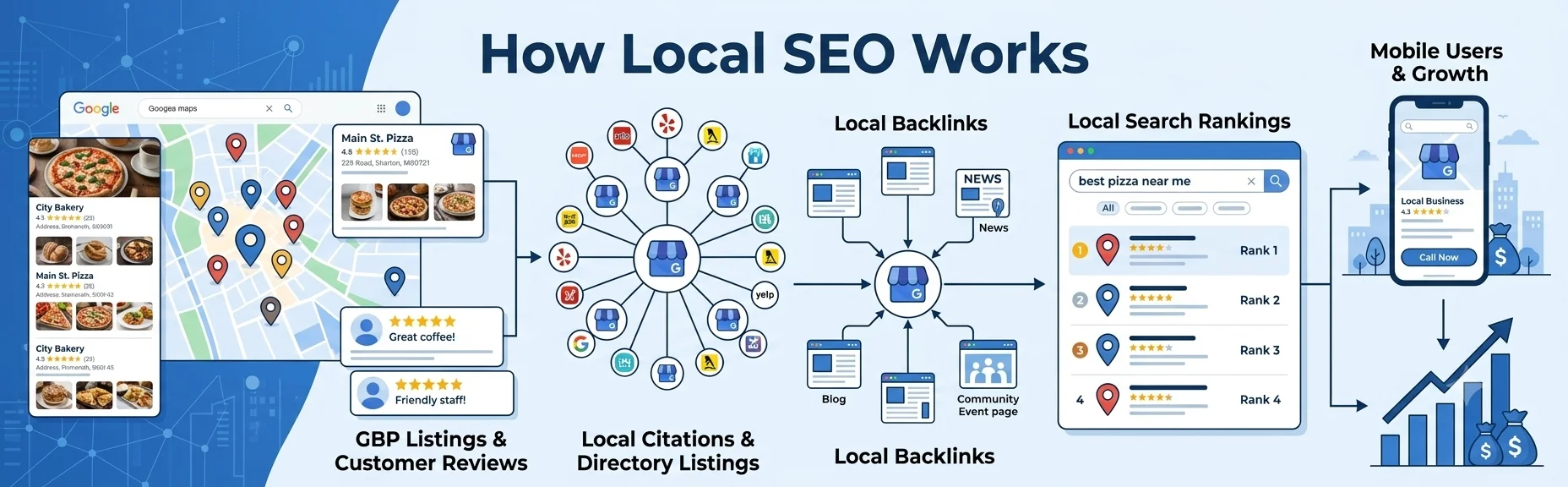
How Google Understands Local Searches
Google’s goal is to provide the most useful result for every search query.
When someone performs a local search, Google analyses multiple factors to determine which businesses best match the user’s intent.
For example:
- Dentist in Camden
- Restaurant near King’s Cross
- Solicitor in Westminster
- Plumber in Croydon
These searches contain clear local intent because the user is looking for a nearby solution.
Google uses data from:
- Google Business Profile
- Website content
- Citations
- Reviews
- Local backlinks
- User behaviour
- Geographic location
This information helps Google understand:
- Where a business is located
- What services it provides
- Which customers it serves
- How trustworthy it appears online
Businesses that optimise these signals often achieve stronger visibility within local search results.
This is one of the key reasons why many companies invest in Local SEO Services in London to strengthen their local presence.
Relevance, Distance and Prominence
Google’s local algorithm is primarily built around three factors:
- Relevance
- Distance
- Prominence
Understanding these signals is essential for improving local rankings.
Businesses looking for a deeper breakdown should also review Local SEO Ranking Factors Explained and Local Search Algorithm Explained.
Relevance Signals
Relevance measures how closely a business matches the user’s search query.
Google evaluates:
- Business categories
- Service descriptions
- Website content
- Keywords
- Products and services
- Business attributes
For example, if a user searches for an Italian restaurant in London, Google will prioritise businesses that clearly indicate they provide Italian cuisine.
This is why local keyword research remains an important part of local SEO.
Businesses should naturally include local keywords throughout:
- Service pages
- Location pages
- Blog content
- Google Business Profile descriptions
The more clearly Google understands a business offering, the easier it becomes to match relevant searches.
Distance Signals
Distance refers to how close a business is to the searcher.
If a user searches for a coffee shop while standing in Soho, Google will usually prioritise nearby options.
However, distance alone does not guarantee visibility.
A highly optimised business with strong authority may outrank a closer competitor if it demonstrates stronger trust signals.
This is particularly important in large cities such as London where multiple businesses compete within the same area.
Businesses serving multiple locations often create borough-specific content and service pages to improve local relevance.
Prominence Signals
Prominence refers to how well-known and trusted a business appears online.
Google evaluates signals including:
- Customer reviews
- Local backlinks
- Brand mentions
- Citations
- Website authority
- User engagement
Businesses with stronger prominence signals are more likely to appear within the Local Pack and Google Maps.
For example, a restaurant with hundreds of positive reviews, local press mentions, and quality backlinks will often rank above a competitor with little online presence.
This is one reason why Google Maps SEO plays such an important role in local search success.
The Role of Google Business Profile
Google Business Profile is one of the most important components of local SEO.
It provides Google with detailed information about a business and helps users quickly access important details.
A complete profile includes:
- Business name
- Address
- Phone number
- Opening hours
- Website
- Photos
- Reviews
- Services
Google uses this information to determine whether a business should appear in local search results.
An optimised profile can increase:
- Calls
- Website visits
- Direction requests
- Customer enquiries
Many businesses improve visibility through Google Business Profile Optimisation in London, which focuses on strengthening profile relevance and engagement.
Google Business Profile also directly influences visibility within How Google’s Local Pack Works, making it one of the most valuable local SEO assets available.
The Importance of Citations and Reviews
Citations and reviews help search engines verify legitimacy and trust.
Citations
A citation is a mention of a business’s:
- Name
- Address
- Phone number
Common citation platforms include:
- Yell
- Apple Maps
- Yelp
- Bing Places
- Thomson Local
Consistent citations strengthen trust and help Google confirm business information.
Reviews
Reviews provide social proof and influence both rankings and consumer behaviour.
Google considers:
- Review quantity
- Review quality
- Review recency
- Business responses
Positive reviews can improve:
- Visibility
- Click-through rates
- Customer trust
- Conversion rates
This is particularly important for sectors such as hospitality where businesses often invest in Local SEO for Restaurants to improve rankings and attract more customers.
How Local Content Supports Rankings
Content remains a crucial part of local SEO.
Google wants to see evidence that a business genuinely serves a particular area.
Local content helps businesses demonstrate geographic relevance while addressing customer needs.
Examples include:
- Area-specific service pages
- Borough landing pages
- Local guides
- Community news
- Case studies
- Industry insights
For example, a London-based business may create content targeting:
- Westminster
- Camden
- Islington
- Barnet
- Croydon
This helps search engines understand service coverage while creating additional ranking opportunities.
Businesses that consistently publish helpful local content often generate more visibility, backlinks, and engagement over time.
Many organisations also discover through Why Small Businesses needs seo services that local content can become one of their most effective lead generation assets.
Conclusion
Local SEO works by helping search engines understand where a business is located, what services it offers, and why it deserves visibility in local search results.
Google evaluates relevance, distance, and prominence while analysing signals from Google Business Profiles, reviews, citations, local backlinks, and website content.
Businesses that optimise these elements improve their chances of appearing in Google Search, Google Maps, and the Local Pack.
As local competition continues to grow, understanding how local SEO works can help businesses build stronger visibility, attract qualified customers, and generate long-term growth through local search.
Whether you run a restaurant, professional service firm, or local trades business, a strong local SEO strategy can become a powerful source of sustainable leads and enquiries.