
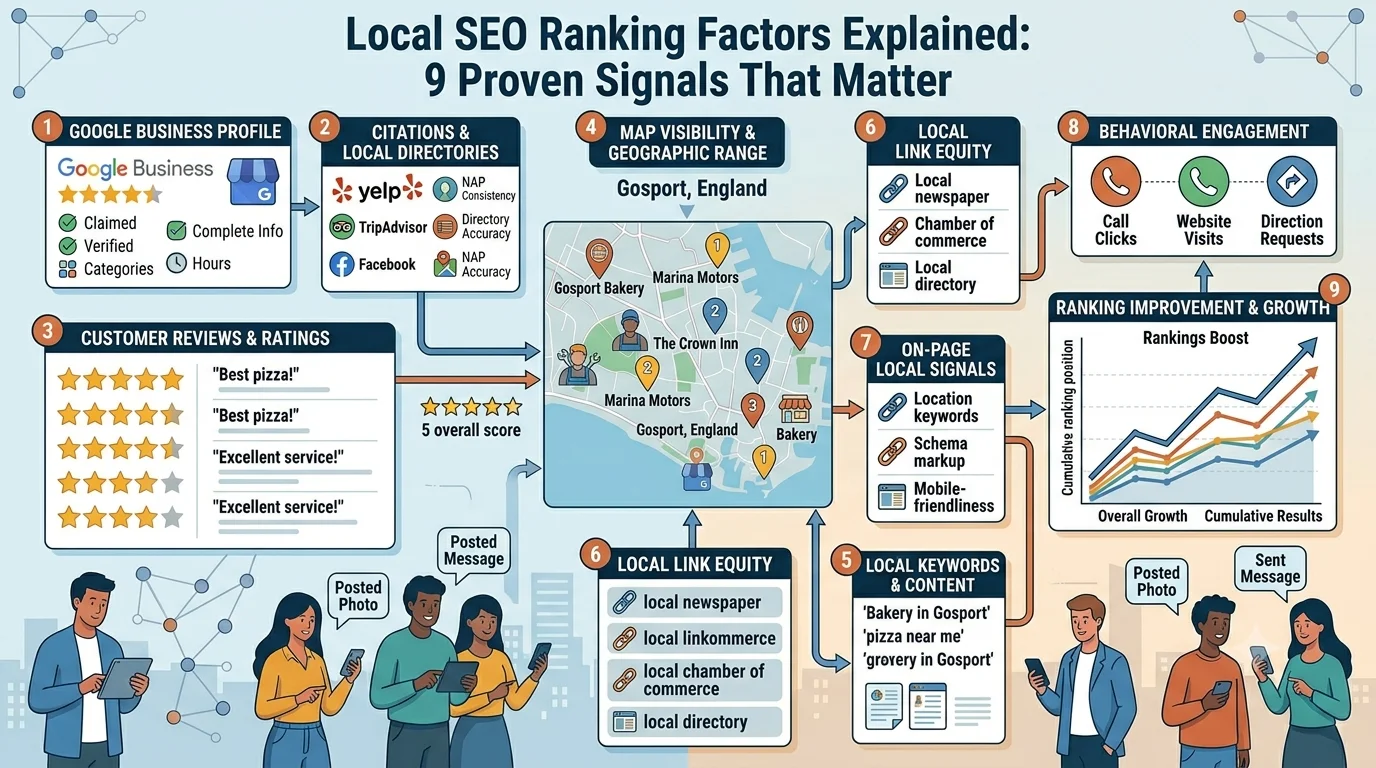
Local SEO Ranking Factors Explained is one of the most important topics for businesses that want to improve their visibility in Google Search, Google Maps, and the Local Pack.
Every day, millions of users search for local products and services. Whether someone is looking for a solicitor in Westminster, a plumber in Croydon, or a restaurant in Camden, Google must decide which businesses deserve to appear at the top of the results.
To make this decision, Google evaluates hundreds of local ranking signals.
Some of these signals relate to your website, while others are connected to your Google Business Profile, customer reviews, citations, and online authority.
Understanding these ranking factors can help businesses improve local visibility, generate more leads, and attract customers who are actively searching for services nearby.
If you are new to local search optimisation, it is helpful to first understand What Is Local SEO before exploring the factors that influence local rankings.
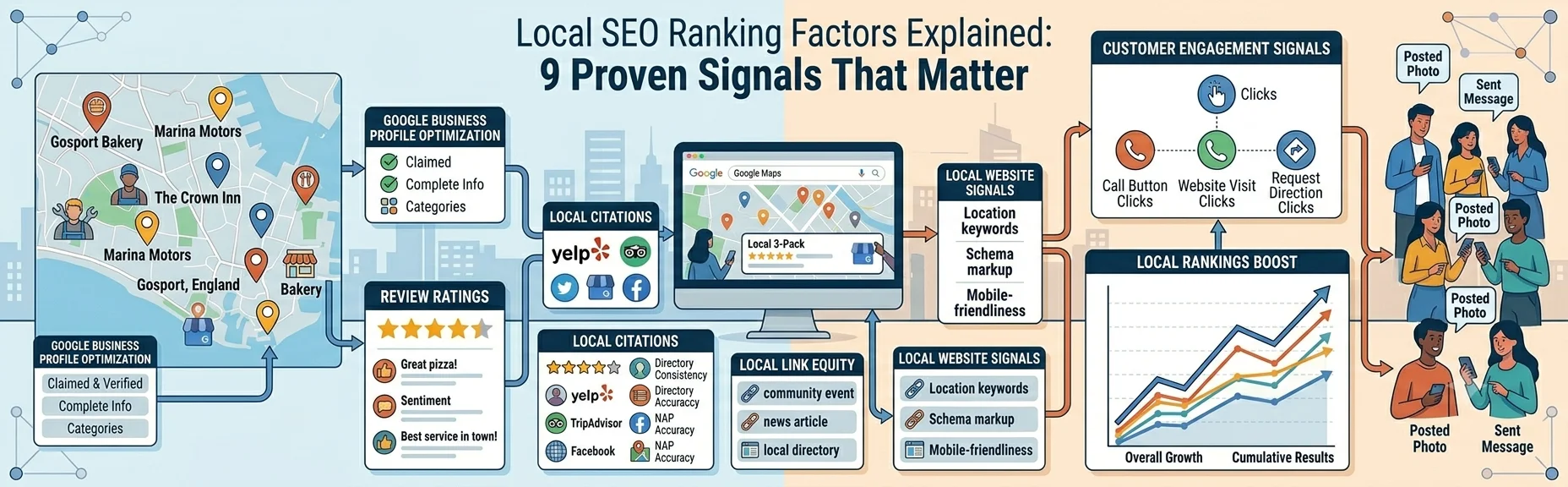
What Influences Local Rankings?
Google’s local algorithm uses a combination of signals to determine which businesses should appear in local search results.
Although Google does not reveal every ranking factor, it has publicly confirmed that three core elements influence local rankings:
- Relevance
- Distance
- Prominence
These concepts form the foundation of local search visibility.
Businesses that understand How Local SEO Works are better positioned to improve each of these ranking factors.
Relevance
Relevance measures how closely a business matches the user’s search query.
Google analyses:
- Business categories
- Service descriptions
- Website content
- Local keywords
- Business attributes
For example, if a user searches for “Italian restaurant in London”, Google will prioritise businesses that clearly indicate they provide Italian cuisine.
This is one reason why businesses invest in local keyword research and structured service pages.
Distance
Distance refers to how close a business is to the user performing the search.
Google uses location data to identify nearby businesses that may satisfy the user’s intent.
However, proximity alone does not guarantee rankings.
Businesses with stronger authority and relevance signals can often outperform closer competitors.
Prominence
Prominence reflects how well-known and trusted a business appears online.
Google evaluates:
- Reviews
- Citations
- Backlinks
- Brand mentions
- Website authority
- Customer engagement
Prominence is one of the strongest ranking factors because it helps Google identify businesses that customers trust.
To better understand how these signals interact, businesses should explore Local Search Algorithm Explained.
Google Business Profile Signals
Google Business Profile remains one of the most influential local ranking factors.
A well-optimised profile helps Google understand:
- What your business does
- Where it is located
- Which customers it serves
- How customers interact with your business
Businesses with complete and actively managed profiles often achieve stronger visibility within Google Search and Maps.
Important Google Business Profile ranking signals include:
Business Categories
Selecting accurate primary and secondary categories helps Google understand your services.
A business should choose the category that most closely reflects its core offering.
Business Information Accuracy
Google values consistency.
Your business name, address, and phone number should remain accurate across all online platforms.
Services and Products
Detailed service information helps Google match your business to relevant searches.
Images and Media
Businesses that regularly upload photographs often achieve stronger engagement.
Images can include:
- Team photos
- Office photographs
- Service examples
- Products
- Customer experiences
Profile Activity
Google prefers active businesses.
Regular updates, posts, and engagement signals demonstrate that a business remains operational and relevant.
Many organisations strengthen these signals through Google Business Profile Optimisation in London.
Google Business Profile is also one of the most important assets within Google Maps SEO because it directly influences map visibility.
Review Signals
Customer reviews play a major role in local search rankings.
Reviews help Google evaluate trust, authority, and customer satisfaction.
They also influence consumer behaviour.
Before contacting a business, many users review ratings, testimonials, and customer feedback.
Google evaluates several review-related factors.
Review Quantity
A business with more authentic reviews often appears more trustworthy.
Review Quality
Positive reviews contribute to stronger trust signals.
Review Recency
Recent reviews indicate that a business remains active and relevant.
Review Responses
Businesses that respond to customer reviews demonstrate engagement and professionalism.
Review management is especially important for sectors such as hospitality, where businesses often invest in Local SEO for Restaurants to strengthen local trust signals.
Reviews also contribute to visibility within Google Maps SEO Services London, where customer trust plays a significant role in ranking performance.
For businesses seeking to improve overall digital visibility, resources such as Learn SEO for Free from an SEO Expert in London can provide useful insights into local ranking improvements.
Citation Signal
A citation is any online mention of a business’s:
- Name
- Address
- Phone Number (NAP)
Google uses citations to verify that a business is legitimate and operates from a real location.
Common citation sources include:
- Yell
- Yelp
- Bing Places
- Apple Maps
- Thomson Local
- Facebook Business Pages
When Google finds consistent business information across multiple trusted platforms, it gains greater confidence in the accuracy of that information.
Why Citation Consistency Matters
One of the most common local SEO mistakes is inconsistent NAP information.
For example:
- Different phone numbers
- Old addresses
- Abbreviated business names
- Duplicate listings
These inconsistencies can confuse both search engines and customers.
Businesses should regularly audit their citations and update outdated information.
Citation Quality vs Citation Quantity
Many business owners believe that more citations automatically lead to better rankings.
In reality, quality is often more important than quantity.
Google values:
- Accurate citations
- Industry-relevant directories
- Trusted local directories
- Well-maintained listings
For London businesses, local relevance can be just as important as authority.
A listing on a respected London directory may provide more value than multiple low-quality directories.
Citation management remains a key component of Local SEO Services in London because it helps strengthen business trust and geographic relevance.
Website Authority and Backlinks
Although local SEO relies heavily on Google Business Profile signals, website authority still plays an important role.
Google wants to recommend businesses that are trusted and respected within their industry.
One way it measures trust is through backlinks.
Backlinks are links from other websites pointing to your website.
They act as endorsements that help search engines evaluate authority.
What Makes a High-Quality Local Backlink?
Not all backlinks carry equal value.
Google generally places more importance on backlinks from:
- Industry websites
- Local publications
- Community organisations
- Chambers of commerce
- Business associations
- Trusted news websites
For example, a London accountant receiving a backlink from a respected London business publication may gain more local authority than a link from an unrelated website.
Local Link Building and Local SEO
Local backlinks help reinforce geographic relevance.
Examples include:
- Local sponsorships
- Community partnerships
- Charity events
- Borough business groups
- Industry events
These links tell Google that your business is actively involved in its local area.
This is one reason why businesses often invest in Google Maps SEO Services London as part of a broader authority-building strategy.
Content and Authority Building
Creating useful content can also help attract backlinks naturally.
Examples include:
- Industry guides
- Local market reports
- Borough-specific resources
- Case studies
- Community-focused content
Businesses that consistently publish valuable information often earn links and mentions from other websites.
This contributes to stronger authority and improved rankings over time.
Many businesses first discover the value of authority building through resources such as Why Small Businesses needs seo services in 2026 and Why Your Business Needs WordPress SEO Experts, which explain how SEO supports long-term business growth.
Behavioural Signals
Behavioural signals help Google understand how users interact with a business online.
Although Google has never disclosed every behavioural metric it uses, research suggests that engagement signals influence local rankings.
Click-Through Rate (CTR)
When users consistently click a business listing, Google may interpret this as a sign that the listing is relevant.
A compelling business profile can improve:
- Clicks
- Calls
- Website visits
Direction Requests
Google Maps tracks how often users request directions to a business.
Frequent direction requests can indicate strong local interest.
Calls and Website Visits
Businesses that generate meaningful engagement through their Google Business Profile often achieve stronger local visibility.
Google sees these interactions as evidence that users find the business useful.
User Engagement
Google evaluates overall engagement through:
- Time spent on site
- Bounce rate
- Page interaction
- Content quality
Businesses that provide valuable information typically generate stronger user engagement.
This is one reason why educational resources such as How Local SEO Works, What Is Local SEO, and Local SEO Statistics for London Businesses can contribute to broader topical authority while supporting local search visibility.
Mobile Experience Matters
Most local searches now happen on mobile devices.
A poor mobile experience can negatively impact:
- User engagement
- Conversions
- Local rankings
Businesses should ensure that websites are:
- Fast-loading
- Mobile-friendly
- Easy to navigate
- Optimised for conversions
A positive user experience supports both rankings and business performance.
Conclusion
Understanding Local SEO Ranking Factors Explained helps businesses make informed decisions about improving their visibility in local search results.
Google evaluates a combination of signals when determining local rankings, including Google Business Profile optimisation, reviews, citations, backlinks, website authority, and user engagement.
No single ranking factor guarantees success.
Instead, strong local SEO performance comes from improving multiple signals that demonstrate relevance, distance, and prominence.
Businesses that maintain accurate citations, generate authentic reviews, build local authority, and provide valuable user experiences are more likely to achieve sustainable visibility in Google Search, Google Maps, and the Local Pack.
As local competition continues to grow, investing in the right ranking factors can help businesses attract more qualified customers and build a stronger online presence.
Whether you operate a local service business, professional practice, or hospitality venue, understanding local ranking factors is a critical step towards long-term search success.