
Local Search Algorithm Explained is a topic every business owner should understand if they want to improve visibility in Google Search and Google Maps.
When someone searches for a nearby service, Google must decide which businesses deserve to appear at the top of the results. Whether the search is for a solicitor in Westminster, a dentist in Camden, or a restaurant in Islington, Google’s local algorithm works behind the scenes to identify the most relevant options.
Unlike traditional search rankings, local search results rely heavily on geographic relevance, business credibility, and user behaviour.
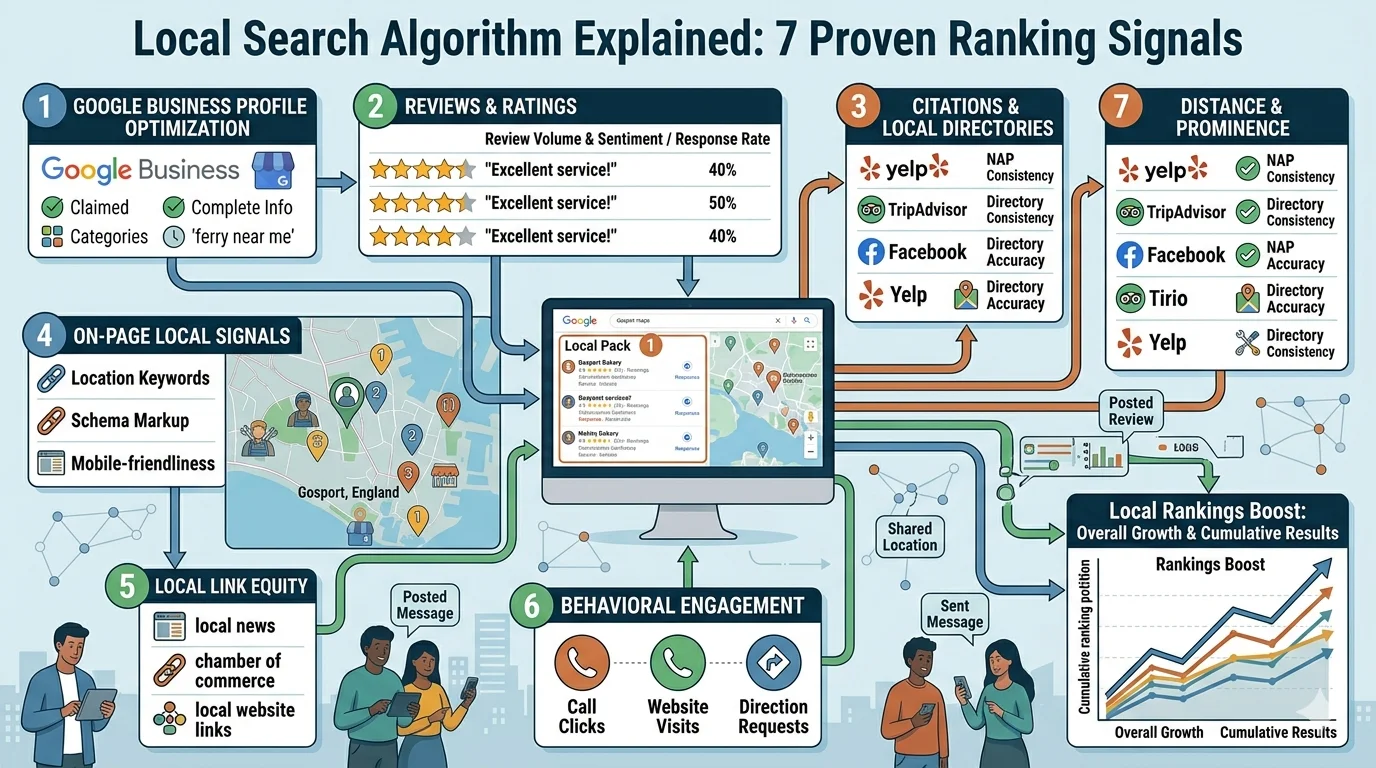
Google analyses a wide range of signals, including:
- Google Business Profile information
- Reviews and ratings
- Local citations
- Backlinks
- User engagement
- Business proximity
- Website content
Understanding how these signals work together can help businesses improve local visibility and attract more qualified customers.
If you’re new to local optimisation, it’s worth reading What Is Local SEO before diving deeper into Google’s ranking systems.
What is Google's Local Algorithm?
Google’s local algorithm is a system designed to rank businesses in location-based searches.
Its purpose is to deliver the most useful and relevant results for users searching within a specific geographic area.
For example, if a customer searches for:
- Accountant in London
- Plumber near me
- Italian restaurant in Camden
- Dentist in Westminster
Google evaluates hundreds of signals before deciding which businesses should appear in the results.
The local algorithm differs from traditional search algorithms because location plays a much bigger role.
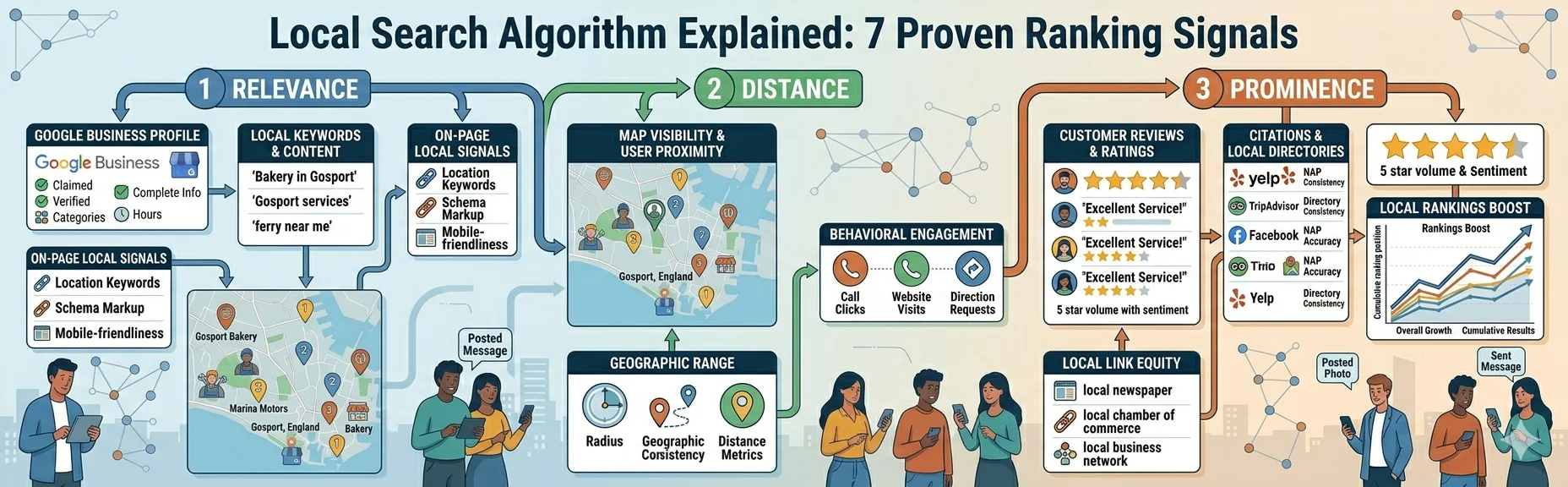
Google publicly states that three primary factors influence local rankings:
- Relevance
- Distance
- Prominence
These factors help Google determine which businesses best match the user’s search intent.
Businesses that understand How Local SEO Works are often better equipped to improve these ranking signals.
Many organisations invest in Local SEO Services in London because understanding the local algorithm can directly impact visibility, enquiries, and revenue.
Relevance
Relevance refers to how closely a business matches the user’s search query.
Google wants to provide the most accurate result possible.
If someone searches for “Italian restaurant in Camden”, Google prioritises businesses that clearly indicate they provide Italian cuisine and operate in the relevant location.
How Google Determines Relevance
Google evaluates several signals to understand business relevance.
These include:
- Business categories
- Service descriptions
- Website content
- Local keywords
- Products and services
- Business attributes
The more information Google has, the easier it becomes to match a business to relevant searches.
Google Business Profile and Relevance
Google Business Profile is one of the most important relevance signals.
A complete profile helps Google understand:
- What a business offers
- Who it serves
- Where it operates
Businesses that regularly update their profile often improve visibility within local search results.
This is why many companies focus on Google Business Profile Optimisation in London to strengthen their local relevance.
Content and Relevance
Website content also plays an important role.
Google analyses service pages, location pages, blogs, and supporting content to understand expertise and relevance.
For example, a restaurant website may publish content related to dining trends, menu updates, and local food events.
This supports relevance while helping Google understand the business’s focus.
Businesses investing in Local SEO for Restaurants often use local content to strengthen geographic and topical relevance.
Search Intent and Relevance
Search intent is another important consideration.
Google aims to match users with businesses that satisfy their needs.
Examples include:
- Informational searches
- Commercial searches
- Transactional searches
- Navigational searches
A business that aligns its content with search intent typically achieves stronger visibility.
For businesses wanting deeper insights into ranking behaviour, Local SEO Ranking Factors Explained provides additional context around the signals Google uses.
Distance
Distance refers to how close a business is to the person performing the search.
Google understands that users often want nearby solutions.
If someone searches for a solicitor while standing in Westminster, Google will generally prioritise businesses located within or near that area.
How Google Measures Distance
Google uses several data points to determine proximity.
These include:
- User location
- Business address
- Service areas
- Geographic relevance
The closer a business is to the searcher, the more likely it is to appear in local results.
However, proximity is not the only ranking factor.
Why Distance Alone Doesn’t Guarantee Rankings
Many businesses assume being physically close to a customer guarantees visibility.
In reality, Google also considers:
- Relevance
- Prominence
- Reviews
- Authority
- User engagement
A highly trusted business with strong reviews and authority may outrank a competitor located closer to the searcher.
Distance and London Businesses
Distance is particularly important in London because search behaviour often varies between boroughs.
A customer searching in Camden may receive different results from someone searching in Croydon, even when using identical keywords.
This is why businesses often create borough-specific content and location pages.
Location-specific strategies help Google understand service coverage and geographic relevance.
Businesses interested in broader local visibility often explore Google Maps SEO and Google Maps SEO Services London to strengthen map-based rankings.
Similarly, analysing Local SEO Statistics for London Businesses can provide useful insights into how local search behaviour differs across areas.
For those looking to improve their SEO knowledge, resources such as Learn SEO for Free from an SEO Expert in London can help businesses better understand local search strategies.
Prominence
Prominence is Google’s way of measuring how well-known and trusted a business appears online.
While relevance and distance focus on matching search intent and location, prominence focuses on authority and reputation.
Google wants to recommend businesses that customers trust and engage with.
A business with strong prominence signals often ranks higher than competitors with weaker online authority.
What Influences Prominence?
Google evaluates several signals when determining prominence.
These include:
- Customer reviews
- Online ratings
- Business citations
- Local backlinks
- Brand mentions
- Website authority
- User engagement
- Media coverage
The stronger these signals are, the more confidence Google has in recommending a business.
Reviews and Trust Signals
Reviews are among the strongest prominence signals.
Google analyses:
- Number of reviews
- Review quality
- Review recency
- Review diversity
- Business responses
Businesses with consistent positive reviews often achieve better local visibility.
For example, a London restaurant with hundreds of recent positive reviews may outperform competitors even if they are located nearby.
This is one reason businesses investing in Local SEO for Restaurants place significant emphasis on review acquisition and reputation management.
Backlinks and Authority
Backlinks remain a major trust signal.
Google sees quality backlinks as endorsements from other websites.
Examples of valuable local backlinks include:
- Local news websites
- Industry publications
- Community organisations
- Chambers of commerce
- Local business directories
Businesses that actively build local authority often improve visibility within both organic search results and Google Maps.
This is one of the reasons many organisations invest in Google Maps SEO Services London to strengthen authority and local relevance simultaneously.
Citations and Brand Mentions
Citations help verify business legitimacy.
When a business is consistently mentioned across trusted directories, Google gains confidence in the accuracy of its information.
Brand mentions also contribute to prominence.
Even when a website does not directly link to your business, Google may still recognise those mentions as authority signals.
Prominence is one of the most important concepts discussed in Local SEO Ranking Factors Explained because it directly impacts long-term ranking performance.
How Google Combines Local Signals
Google does not rely on a single ranking factor.
Instead, it combines multiple signals to determine which businesses deserve visibility.
The local algorithm constantly evaluates:
- Relevance
- Distance
- Prominence
Alongside supporting factors such as:
- Google Business Profile activity
- Website content
- Reviews
- Citations
- Backlinks
- User behaviour
- Mobile experience
Example of Signal Combination
Imagine two accountants serving Westminster.
Business A:
- Located closer to the searcher
- Few reviews
- Weak website
- Limited authority
Business B:
- Slightly further away
- Strong review profile
- High-quality backlinks
- Well-optimised Google Business Profile
Google may rank Business B higher because its overall authority and trust signals outweigh the slight proximity advantage.
This demonstrates why businesses should focus on improving multiple ranking factors rather than relying on a single optimisation tactic.
User Behaviour Matters
Google also evaluates how users interact with businesses.
Examples include:
- Click-through rates
- Calls
- Website visits
- Direction requests
- Time spent on site
These behavioural signals help Google understand whether users find a business useful.
Businesses looking to improve user engagement often strengthen their websites through guidance found in Why Your Business Needs WordPress SEO Experts.
Topical Authority and Local Search
Google increasingly rewards businesses that demonstrate expertise through content.
Publishing helpful content around:
- Services
- Locations
- Industry trends
- Customer questions
helps build topical authority.
Resources such as What Is Local SEO, How Local SEO Works, and Local SEO Statistics for London Businesses support broader semantic coverage and strengthen a website’s overall authority.
Future Trends in Local Search
Local search continues to evolve as Google introduces new technologies and ranking signals.
Businesses that understand future trends can prepare for changes before competitors.
AI and Local Search
Artificial intelligence is becoming increasingly important.
Google now uses advanced AI systems to better understand:
- Search intent
- Context
- User behaviour
- Business relevance
This means businesses must focus on creating genuinely useful content rather than relying on outdated SEO tactics.
Google Business Profile Will Become More Important
Google Business Profile continues to play a central role in local rankings.
Future updates are likely to place even greater emphasis on:
- Customer engagement
- Profile completeness
- Reviews
- Business activity
Businesses already investing in Google Business Profile Optimisation in London are often better prepared for these changes.
Mobile Search Growth
Most local searches now happen on mobile devices.
As mobile usage increases, Google will continue prioritising:
- Fast websites
- Mobile usability
- User experience
Businesses that ignore mobile optimisation may struggle to compete.
Hyper-Local Search Expansion
Google is becoming more precise when identifying user locations.
This means businesses may need:
- Borough-specific pages
- Location-focused content
- Area-specific reviews
- Hyper-local optimisation
For London businesses, this trend creates opportunities to target highly specific locations and customer needs.
The Growing Importance of Local SEO
As competition increases, more organisations are recognising the value of local search.
Many businesses exploring growth opportunities discover resources such as Why Small Businesses needs seo services in 2026 and Local SEO Services in London while planning long-term digital marketing strategies.
Conclusion
Local Search Algorithm Explained provides valuable insight into how Google determines which businesses appear in local search results.
The algorithm is built around three primary factors:
- Relevance
- Distance
- Prominence
Google combines these factors with signals from Google Business Profiles, reviews, citations, backlinks, website content, and user engagement to determine rankings.
Businesses that optimise these signals improve their chances of appearing in Google Search, Google Maps, and the Local Pack.
While the algorithm continues to evolve, the fundamentals remain consistent: provide accurate information, build trust, create useful content, and deliver a positive customer experience.
By understanding how Google’s local algorithm works, businesses can make smarter SEO decisions and build stronger visibility within their target markets.