
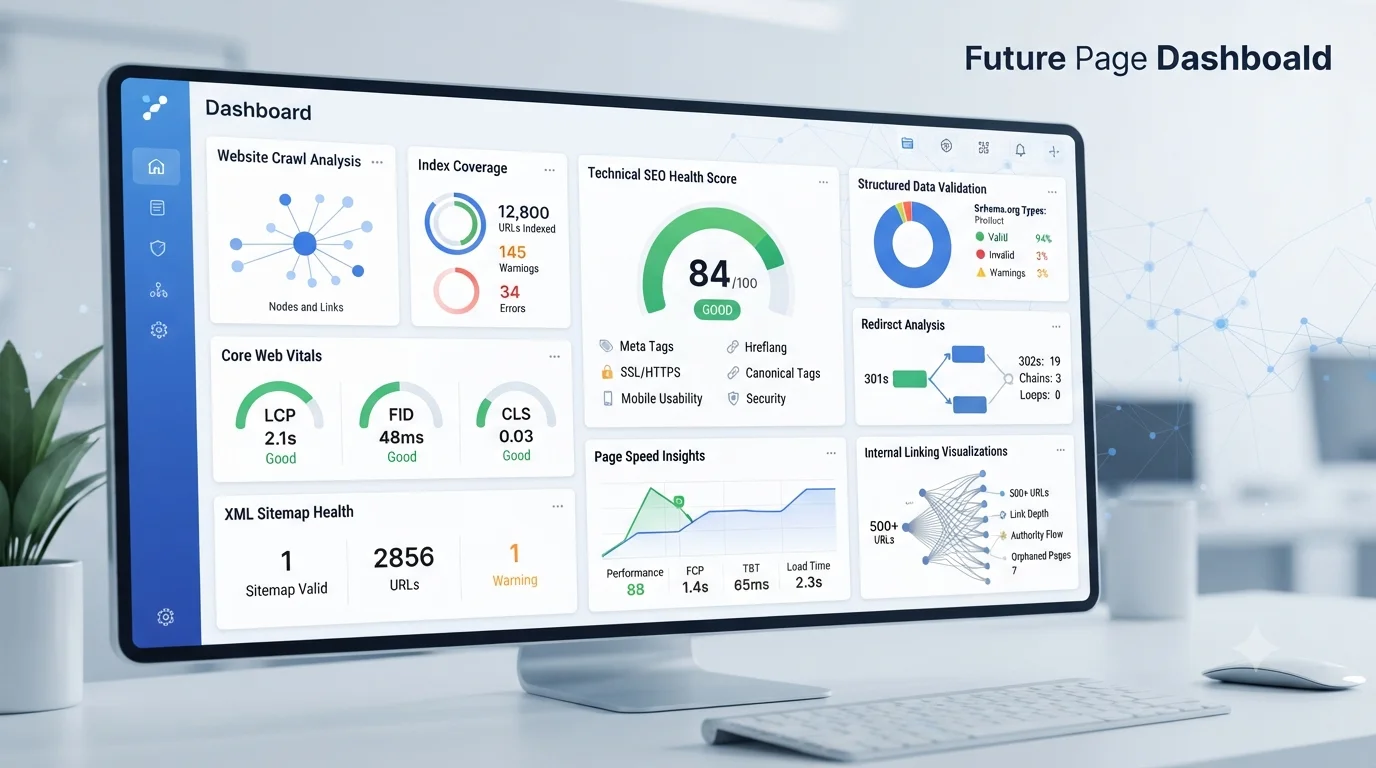
If your website isn’t generating the organic traffic, enquiries or sales you expect, an SEO audit is the most effective place to start. Before investing in content, link building or paid marketing, it’s important to understand what’s preventing your website from performing in Google Search and AI-powered search experiences.
I provide professional SEO audit services for small businesses, ecommerce websites and enterprise organisations across the UK. Every audit is carried out manually using industry-leading SEO tools, combined with my own technical analysis and experience. Rather than sending you an automated report filled with generic recommendations, I identify the issues that genuinely affect your website’s visibility and prioritise the improvements that will deliver the greatest business impact.
Whether you’re struggling with declining rankings, poor indexation, slow-loading pages or low conversion rates, my SEO audit provides a clear roadmap for improving your website’s performance. If your business depends on local customers, I’ll also assess how your website supports Local SEO Services and your Google Business Profile Optimisation strategy to maximise local search visibility.
Throughout the audit, I follow Google’s best practices outlined in Google Search Essentials and use trusted guidance from Google Search Central to ensure recommendations align with current search engine standards.
What Are SEO Audit Services?
An SEO audit is a comprehensive review of your website that identifies the technical, content and structural issues preventing it from achieving its full organic search potential. While many businesses focus on publishing more content or targeting additional keywords, these efforts often produce limited results if the underlying website isn’t technically sound.
A professional SEO audit answers one important question:
What’s stopping this website from ranking as well as it should?
The answer isn’t always a technical fault. In many cases, I discover that websites have strong content but weak internal linking, competing pages targeting the same keyword, poor information architecture or content that no longer matches user search intent. These hidden issues often limit organic performance more than missing keywords or metadata.
Unlike automated audit tools that generate hundreds of warnings without explaining their importance, I analyse your website manually to understand how search engines and users interact with it. Every recommendation is prioritised according to its likely impact on your rankings, traffic and business goals.
A complete SEO audit typically evaluates:
- Website crawlability and indexability
- Site architecture and navigation
- Technical SEO implementation
- Page speed and Core Web Vitals
- Content quality and topical relevance
- Internal linking structure
- Structured data and Schema markup
- Keyword targeting
- Mobile usability
- Duplicate content
- Redirects and broken links
- XML sitemaps and robots.txt
- Backlink profile
- Local SEO signals where relevant
Many of these areas are explored in greater depth through my Technical SEO Services, which focus on resolving the technical issues identified during the audit.
Expert Insight
One of the most common problems I uncover isn’t a broken website—it’s a website that has gradually become difficult for search engines to understand. Over time, businesses publish new pages, update services and expand their content without reviewing how everything connects together. This often creates competing pages, inconsistent internal linking and weak topical relationships that reduce organic visibility.
Why Every Business Needs an SEO Audit
Search engines continually update how they evaluate websites, while businesses regularly add new content, redesign pages and introduce new technologies. As websites evolve, SEO issues naturally develop, often without anyone noticing.
An SEO audit helps uncover these issues before they affect your rankings, traffic and conversions.
Some of the most common problems I identify include:
- Important pages that aren’t indexed by Google.
- Poor internal linking that hides valuable pages from search engines.
- Slow-loading pages affecting user experience and Core Web Vitals.
- Duplicate or outdated content reducing topical relevance.
- Incorrect canonical tags causing indexation issues.
- Broken redirects and 404 errors.
- Thin service pages that don’t fully satisfy search intent.
- Missing or incomplete structured data.
- Weak website architecture.
- Keyword cannibalisation between similar pages.
- Images that aren’t optimised for search.
- Technical issues affecting mobile usability.
Many of these problems aren’t immediately visible to website owners, but they can significantly reduce your ability to compete in organic search.
For local businesses, these technical issues can also affect visibility in Google’s Local Pack. That’s why I often recommend combining an SEO audit with How Google’s Local Pack Works, Local SEO Ranking Factors Explained, and What Is Local SEO? to better understand how technical optimisation supports local rankings.
What's Included in My SEO Audit Service?
Every website is different, so I don’t believe in one-size-fits-all SEO audits. A local trades business has very different priorities from an ecommerce retailer or an enterprise organisation, which is why every audit is tailored to your business goals, industry and website structure.
My SEO audit combines technical analysis, content evaluation and competitor research to create a prioritised action plan that supports long-term organic growth.
Technical SEO Audit
Technical SEO forms the foundation of every successful website. If search engines struggle to crawl, render or index your pages, even the best content may fail to rank.
During the technical audit, I review:
- Crawlability and indexation
- XML sitemap health
- Robots.txt configuration
- Canonical tags
- Redirect chains and loops
- Broken internal and external links
- HTTPS implementation
- JavaScript rendering issues
- Crawl depth
- URL structure
- Pagination
- Mobile usability
- Core Web Vitals
- Structured data implementation
Where improvements are required, I’ll explain not only what needs fixing but why it matters and how it contributes to better organic performance. Businesses requiring ongoing implementation can also benefit from my Technical SEO Services, which focus on resolving these issues and improving overall website health.
On-Page SEO Audit
Once the technical foundations are in place, I review how effectively each important page communicates its topic to both users and search engines.
This includes evaluating:
- Keyword targeting
- Search intent alignment
- Title tags and meta descriptions
- Heading hierarchy
- Content depth
- Information gain
- Image optimisation
- Internal linking opportunities
- User experience
- Calls to action
Rather than simply recommending more keywords, I assess whether your content genuinely answers the questions your audience is asking. Where relevant, I will identify opportunities to strengthen your content by linking naturally to supporting resources such as SEO Agency in Portsmouth, Local SEO Services, and other related pages across your website, helping build stronger topical authority.
Content Quality & Information Gain Audit
Creating content isn’t enough to rank well in Google. Every page should demonstrate expertise, satisfy search intent and provide information that users can’t easily find elsewhere. One of the biggest reasons websites fail to gain organic visibility is because their content is either too thin, outdated or too similar to competing pages.
As part of my SEO audit, I assess whether your content genuinely helps users solve their problems while supporting your wider business goals. Rather than focusing solely on keywords, I evaluate how effectively each page answers search intent, builds topical authority and encourages users to take the next step.
My content audit includes:
- Search intent alignment
- Content depth and topical coverage
- Information gain compared with competitors
- Keyword relevance and semantic optimisation
- Duplicate and thin content analysis
- Content freshness
- Readability and user engagement
- Content hierarchy
- Featured snippet opportunities
- AI search optimisation
Where appropriate, I’ll recommend opportunities to strengthen your content by connecting it with supporting resources such as What Is Local SEO?, Local SEO Ranking Factors Explained, How Google’s Local Pack Works, and Technical SEO Services. This creates a stronger topical relationship between pages while helping search engines understand your expertise.
Expert Insight
One of the biggest misconceptions about SEO is that publishing more content automatically leads to better rankings. In reality, Google rewards content that demonstrates expertise, answers user questions comprehensively and fits naturally within a well-organised website structure. A smaller collection of high-quality pages often outperforms hundreds of poorly connected articles.
Internal Linking & Website Architecture Audit
Internal links are one of the most overlooked ranking factors. They help search engines discover new content, understand topical relationships and distribute authority throughout your website.
During my audit, I evaluate whether your internal linking strategy supports your most important commercial pages or unintentionally weakens them.
I assess:
- Website navigation
- Page hierarchy
- Click depth
- Orphan pages
- Topic clusters
- Internal anchor text
- Contextual linking opportunities
- Service-to-blog connections
- Blog-to-service connections
- Authority flow across the website
For example, if your goal is to improve rankings for SEO Agency in Portsmouth, every supporting article should reinforce that page through relevant contextual links rather than competing for the same keywords.
Likewise, service pages should naturally reference supporting resources such as Technical SEO Services, Google Business Profile Optimisation, Local SEO Services, and SEO Cost Portsmouth, creating a clear topical cluster that search engines can easily understand.
A strong internal linking strategy doesn’t just help Google—it also guides visitors towards related content, increasing engagement and helping potential clients learn more about your services.
Page Experience & Core Web Vitals Audit
A fast, accessible and user-friendly website provides a better experience for visitors and supports long-term SEO performance.
Although page experience alone won’t guarantee higher rankings, technical performance can influence how users interact with your website. Slow-loading pages often lead to higher bounce rates, lower engagement and missed conversion opportunities.
As part of the audit, I analyse:
- Core Web Vitals
- Largest Contentful Paint (LCP)
- Interaction to Next Paint (INP)
- Cumulative Layout Shift (CLS)
- Mobile responsiveness
- Image optimisation
- JavaScript performance
- CSS rendering
- Server response times
- Browser caching
Where relevant, I benchmark your website using Google PageSpeed Insights, Google Lighthouse, and Google’s guidance on Core Web Vitals to identify opportunities for improvement.
Rather than chasing perfect performance scores, I focus on practical improvements that enhance both user experience and search performance.
Structured Data & Schema Audit
Structured data helps search engines better understand the purpose and content of your website. While schema markup isn’t a direct ranking factor, it improves how search engines interpret information and may increase your chances of earning enhanced search results.
During the audit, I review:
- Organisation schema
- Local Business schema
- Service schema
- FAQ schema
- Breadcrumb schema
- Article schema
- Product schema (for ecommerce websites)
- Review schema where appropriate
I also validate your structured data using Schema.org guidance and Google Rich Results Test to identify implementation issues and enhancement opportunities.
For local businesses, accurate schema complements your Google Business Profile Optimisation strategy and helps strengthen local search signals.
Competitor & SERP Analysis
An SEO audit shouldn’t only evaluate your website—it should also explain why competitors are outperforming you.
That’s why I analyse the websites currently ranking for your target keywords to understand what Google considers the most relevant and authoritative results.
My competitor analysis examines:
- Content depth
- Search intent coverage
- Keyword targeting
- Website architecture
- Internal linking strategy
- Backlink profile
- User experience
- SERP features
- Information gain
- E-E-A-T signals
Rather than copying competitors, I identify the gaps they haven’t addressed and the opportunities your website can use to stand out.
For example, if competitors provide generic explanations of SEO audits but don’t explain business impact or AI search readiness, those become opportunities to create more valuable content that better satisfies user intent.
This approach is one of the reasons I recommend connecting service pages with supporting resources like SEO Agency in Portsmouth and Technical SEO Services, helping build topical authority instead of relying on isolated pages.
Local SEO Audit
If your business relies on customers within a specific town, city or region, local SEO should be an essential part of your website strategy.
A Local SEO Audit evaluates how effectively your website supports visibility in Google’s Local Pack, Google Maps and location-based search results.
This includes reviewing:
- Google Business Profile optimisation
- NAP (Name, Address and Phone Number) consistency
- Local landing pages
- Local keyword targeting
- Location-based content
- Local citations
- Local schema markup
- Reviews and reputation signals
- Internal links between service and location pages
For businesses targeting Portsmouth, London or other competitive areas, I also assess how well your local content supports commercial pages such as SEO Agency in Portsmouth, while recommending improvements through related resources like Local SEO Services, How Google’s Local Pack Works, and Local Search Algorithm Explained.
A strong local SEO strategy helps search engines understand where you operate, who you serve and why your business is relevant for location-based searches.
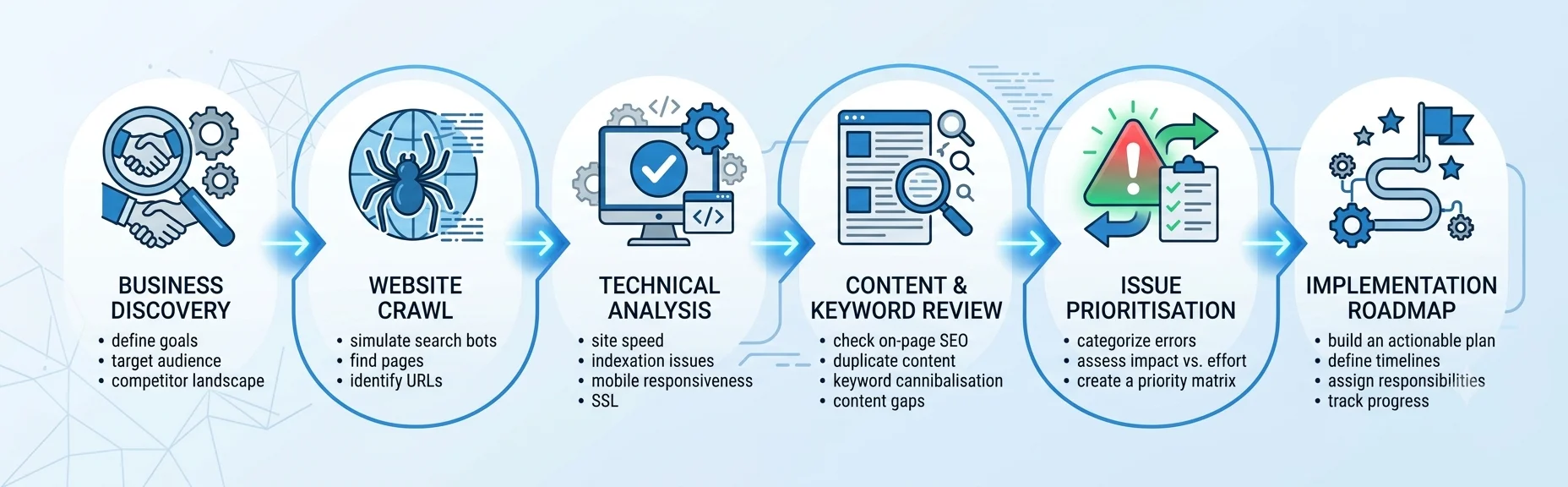
My 7-Step SEO Audit Process
Every SEO audit follows a structured methodology designed to identify the issues that matter most to your website’s performance. Rather than relying on automated reports, I combine professional SEO tools with manual analysis to produce practical recommendations you can act on.
Step 1 – Discovery Call
I begin by understanding your business, target audience, website objectives and current SEO challenges. This ensures the audit focuses on the areas that will have the greatest impact.
Step 2 – Access to Google Search Console & GA4
I review your Google Search Console and Google Analytics 4 data to identify indexing issues, keyword performance, user behaviour and existing opportunities.
Step 3 – Website Crawl Using Screaming Frog
Using Screaming Frog, I crawl your website to uncover technical issues affecting crawlability, indexation, redirects, metadata, duplicate content and internal linking.
Step 4 – Manual SEO Analysis
I manually review your most important pages to evaluate search intent, content quality, information gain, user experience and conversion opportunities—areas that automated tools often overlook.
Step 5 – Competitor Review
I compare your website with key competitors to identify content gaps, technical advantages and opportunities to strengthen your organic visibility.
Step 6 – Priority Report
You’ll receive a prioritised report that categorises recommendations into high, medium and low priority, helping you focus on the improvements likely to deliver the greatest return.
Step 7 – Walkthrough Meeting
Finally, I walk you through the findings, explain each recommendation in plain English and answer any questions. My goal is to ensure you understand not only what should change, but why those changes matter and how they support your long-term SEO strategy.
What You'll Receive After Your SEO Audit
An SEO audit should do more than identify problems—it should give you a practical roadmap for improving your website’s performance. My goal is to provide clear, prioritised recommendations that help you understand what to fix first, why it matters and how each improvement contributes to better rankings, traffic and conversions.
After completing your audit, you’ll receive a detailed report that includes:
- Executive summary with key findings
- Technical SEO recommendations
- On-page SEO improvements
- Content quality and information gain analysis
- Internal linking opportunities
- Website architecture recommendations
- Page speed and Core Web Vitals assessment
- Competitor analysis
- Local SEO recommendations (where applicable)
- Priority action plan
- Quick wins for immediate improvements
- Long-term SEO roadmap
Rather than overwhelming you with hundreds of technical warnings, I explain every recommendation in plain English, making it easier to understand the impact on your website and the steps needed to improve its performance.
Where appropriate, I’ll also recommend supporting services such as Technical SEO Services, Local SEO Services, or content improvements that strengthen important commercial pages like SEO Agency in Portsmouth.
Who My SEO Audit Services Are For?
Every website can benefit from an SEO audit, whether you’re launching a new business, redesigning your website or trying to recover from declining organic traffic.
My SEO audit services are ideal for:
Small Businesses
If your website isn’t generating enough enquiries or you’re struggling to compete locally, an SEO audit identifies the issues preventing your business from reaching more potential customers. I also assess opportunities to strengthen Local SEO Services, improve your Google Business Profile Optimisation, and increase visibility in Google’s Local Pack.
Ecommerce Websites
Ecommerce websites often contain hundreds or even thousands of pages, making technical SEO especially important. I review category pages, product pages, duplicate content, crawl efficiency, internal linking and structured data to ensure your online store is easy for search engines to understand and customers to navigate.
Google Search Console Quick Wins
One of the most valuable resources during an SEO audit is Google Search Console.
It provides real performance data that helps identify opportunities already available within your website.
During an audit, I look for:
- Pages ranking on page two of Google.
- High-impression, low-click pages.
- Declining keyword performance.
- Indexing issues.
- Crawl anomalies.
- Underperforming landing pages.
These insights often reveal opportunities that can be improved far more quickly than creating entirely new content.
For example, improving page titles, strengthening internal links or expanding existing content can often increase visibility without requiring a complete website rebuild.
Enterprise Websites
Large websites frequently develop technical challenges as they grow. I assess complex site architecture, crawl budget, indexation, canonical implementation and content duplication to help enterprise websites maintain strong organic performance.
Local Businesses
Whether you serve customers in Portsmouth, London or across the UK, I evaluate how effectively your website supports local search visibility. This includes reviewing location pages, local keyword targeting, citations, structured data and internal linking with resources such as How Google’s Local Pack Works, Local SEO Ranking Factors Explained, and Local Search Algorithm Explained.
Businesses Recovering from Organic Traffic Declines
If your rankings or traffic have dropped, an SEO audit helps identify the likely causes. These may include technical issues, content quality, algorithm updates, website migrations or increased competition. My recommendations focus on resolving these issues while supporting sustainable long-term growth.
Expert Insight
One of the biggest mistakes I see businesses make is assuming that more content will solve every SEO problem. In reality, improving existing content, strengthening internal linking and fixing technical issues often delivers a greater return than publishing dozens of new articles. An effective SEO strategy starts with understanding what’s already limiting your website.
Why Work With Me?
Choosing the right SEO consultant is about more than finding someone who can run an audit tool. You need someone who can interpret the data, explain the findings clearly and recommend practical actions that support your business goals.
When you work with me, you’ll receive a manually reviewed SEO audit tailored to your website—not a generic report generated in a few minutes.
Here’s what you can expect:
- A personalised approach based on your business objectives.
- Manual analysis alongside professional SEO tools.
- Transparent recommendations with no unnecessary upselling.
- Clear explanations in plain English.
- Prioritised actions based on potential business impact.
- Practical advice that supports long-term SEO growth.
- Recommendations aligned with Google’s best practices and modern AI-powered search experiences.
My expertise covers technical SEO, content strategy, local SEO and website optimisation, allowing me to assess your website from multiple perspectives rather than focusing on a single aspect of SEO.
Whether you’re looking to improve rankings, increase qualified traffic or generate more enquiries, my goal is to provide recommendations that deliver measurable value rather than simply highlighting problems.
What do SEO audit services include?
How often should I have an SEO audit?
Can an SEO audit improve rankings?
What tools do you use during an SEO audit?
What's the difference between a technical SEO audit and a full SEO audit?
How long does an SEO audit take?
Will you implement the recommendations?
Do I need to provide access to Google Search Console and Google Analytics?
How much do SEO audit services cost?
Ready to Improve Your Website's SEO Performance?
If your website isn’t achieving the visibility, traffic or enquiries you expect, an SEO audit is the first step towards understanding why. By identifying technical issues, content gaps and missed optimisation opportunities, you’ll gain a clear plan for improving your website’s performance in both traditional search engines and AI-powered search experiences.
Whether you’re a small business looking to strengthen your local presence, an ecommerce store aiming to increase online sales or an organisation managing a large website, I provide practical, evidence-based recommendations tailored to your goals.
If you’re ready to uncover what’s limiting your website’s organic performance, get in touch today to discuss your requirements. Together, we can build a stronger technical foundation, improve your content strategy and create a website that’s better equipped to compete in today’s search landscape.