

A strong SEO strategy starts with a technically healthy website. Even the most valuable content and well-planned keyword strategy can struggle to perform if search engines can’t efficiently crawl, understand and index your pages.
My technical seo services focus on improving the technical foundation of your website so that both users and search engines can access your content without unnecessary barriers. Rather than relying on automated reports alone, I analyse your website manually alongside industry-leading SEO tools to identify the issues that genuinely affect rankings, website performance and long-term organic growth.
Whether you run a local business, an eCommerce store or a growing B2B company, I provide practical recommendations prioritised by business impact rather than simply listing technical errors. Every improvement is designed to strengthen your website’s visibility today while preparing it for future search developments, including AI-powered search experiences.
Technical optimisation also provides the foundation for successful on-page seo services, content improvements and sustainable SEO growth.
What Are Technical SEO Services?
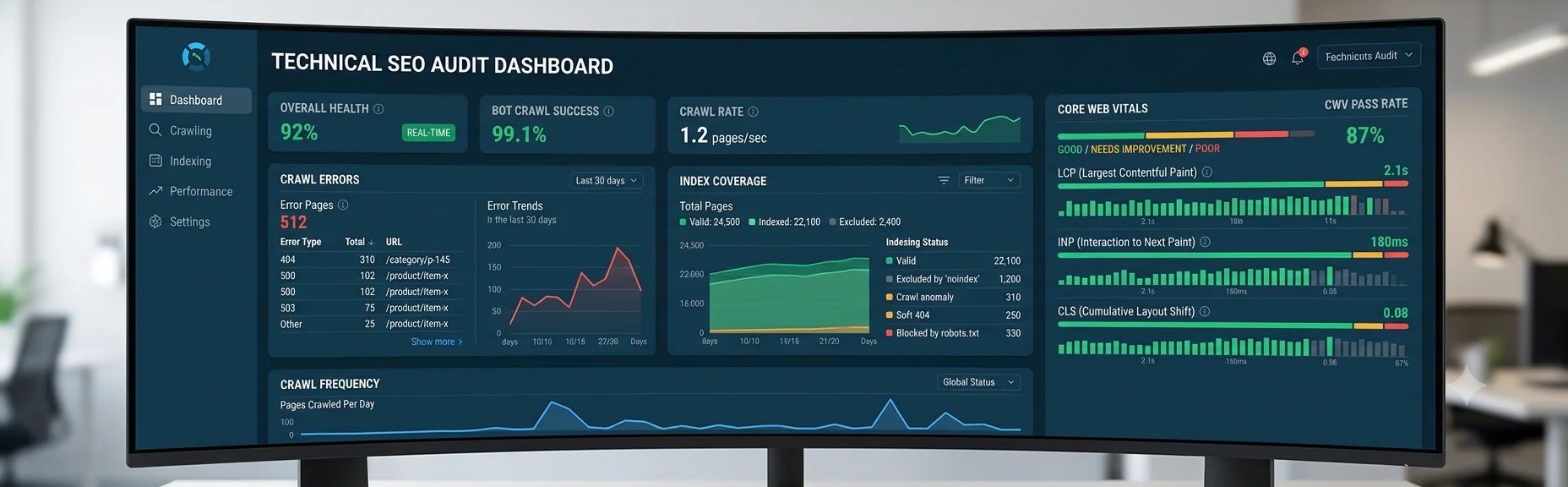
Technical SEO services improve the technical foundation of your website by ensuring search engines can efficiently crawl, index, understand and rank your pages. They focus on website performance, crawlability, indexation, structured data and user experience to support long-term organic visibility.
Many people think SEO is simply about keywords and content. While those elements remain important, they can only perform effectively when supported by a technically sound website.
Technical SEO focuses on improving the infrastructure behind your website rather than the visible content. It helps search engines discover your pages more efficiently while providing visitors with a faster, more reliable browsing experience.
As part of my technical SEO services, I assess areas including:
- Crawlability and indexability.
- Website architecture.
- XML sitemaps.
- robots.txt configuration.
- Canonical tags.
- Redirect management.
- Core Web Vitals.
- Mobile usability.
- HTTPS implementation.
- Structured data.
- Internal linking.
- JavaScript rendering.
- Crawl budget efficiency.
Rather than treating these as isolated technical tasks, I evaluate how they work together to influence your website’s ability to rank and provide a positive user experience.
Technical SEO is not about achieving a perfect score in every SEO tool. It’s about removing the obstacles that prevent search engines from understanding your website while creating a strong foundation for sustainable organic growth.
Why Technical SEO Matters
Search engines aim to deliver the best possible experience for users.
If your website is difficult to crawl, contains indexing issues or loads slowly, even exceptional content may struggle to achieve its full ranking potential.
Technical SEO helps ensure your website remains accessible, efficient and easy for search engines to interpret.
Some of the most common issues I discover include:
- Pages excluded from Google’s index.
- Broken internal links.
- Redirect chains.
- Incorrect canonical tags.
- Slow-loading pages.
- Poor Core Web Vitals.
- Orphan pages.
- XML sitemaps containing redirected URLs.
- Duplicate content.
- Missing structured data.
These issues often develop gradually following website updates, redesigns or content expansion. Left unresolved, they can reduce crawl efficiency, waste crawl budget and limit your website’s ability to compete in organic search.
By identifying and resolving these problems early, technical SEO helps improve website performance while creating a stronger foundation for future optimisation.
Technical SEO vs On-Page SEO
Technical SEO and on-page SEO work together, but they focus on different aspects of website optimisation.
Technical SEO ensures search engines can successfully access, crawl and understand your website.
On-page seo services, on the other hand, focus on improving the content users see, including headings, metadata, keyword targeting, search intent, internal links and overall content quality.
| Technical SEO | On-Page SEO |
|---|---|
| Crawlability | Content optimisation |
| Indexability | Keyword targeting |
| XML sitemaps | Heading structure |
| Canonical tags | Meta titles and descriptions |
| Core Web Vitals | Search intent alignment |
| Structured data | Internal content links |
Neither should be viewed in isolation.
A technically healthy website supports effective on-page optimisation, while well-optimised content gives search engines valuable information to rank.
That’s why I always consider technical SEO as part of a wider optimisation strategy rather than a standalone service.
My Technical SEO Process
Every website is different.
An eCommerce website with thousands of products requires a different technical strategy from a local trades business or a professional services website.
Rather than relying on automated reports, I combine professional SEO tools with manual analysis to understand how your website performs from both a technical and business perspective.
Every recommendation is prioritised according to its potential impact on search visibility, user experience and long-term business growth.
Understanding Your Website and Business Goals
Before reviewing technical issues, I take time to understand your business.
This includes reviewing:
- Your products or services.
- Target audience.
- Current website performance.
- Existing SEO strategy.
- Competitor landscape.
- Commercial objectives.
Understanding your goals ensures the technical recommendations I make align with your wider business priorities rather than following a generic SEO checklist.
I also review your current visibility using Google Search Console to identify existing strengths, opportunities and potential quick wins.
Technical Website Crawl
Once I understand your business, I perform a comprehensive crawl of your website using professional SEO software.
This allows me to identify issues affecting how search engines discover and interpret your content.
During this stage, I assess:
- Crawlability.
- Indexability.
- HTTP status codes.
- XML sitemap health.
- robots.txt directives.
- Canonical tags.
- Redirect chains.
- Internal linking.
- Duplicate URLs.
- Broken links.
- Crawl depth.
- Website architecture.
One memorable project involved important service pages remaining unindexed because incorrect canonical tags pointed to alternative URLs. After correcting the canonical tags, updating the XML sitemap and requesting reindexing through Google Search Console, those pages were successfully indexed and gradually gained organic visibility.
This is a good example of why technical SEO goes beyond automated audits. The tools identified the issue, but understanding its impact and prioritising the right fix required manual investigation.
Performance and Core Web Vitals Review
Website performance influences both user experience and search visibility.
As part of every technical review, I evaluate how efficiently your website loads and performs across desktop and mobile devices.
This includes reviewing:
- Core Web Vitals.
- Largest Contentful Paint (LCP).
- Interaction to Next Paint (INP).
- Cumulative Layout Shift (CLS).
- Image optimisation.
- JavaScript and CSS efficiency.
- Server response times.
- Mobile responsiveness.
- Browser caching.
Rather than chasing perfect PageSpeed scores, I focus on practical improvements that make a measurable difference to user experience and website performance.
Website Architecture and Internal Linking
A well-structured website helps search engines understand the relationship between your pages.
During technical optimisation, I review:
- Navigation structure.
- URL hierarchy.
- Internal linking.
- Orphan pages.
- Crawl depth.
- Anchor text distribution.
I’ve audited websites where valuable pages received no internal links, making them difficult for search engines to discover. By improving navigation and internal linking, these pages became easier to crawl, strengthening both visibility and user experience.
This process also creates natural opportunities to strengthen related services such as content seo services and keyword research services, ensuring your technical foundation supports your wider SEO strategy.
Structured Data and Indexation
Technical SEO isn’t just about helping search engines find your pages. It’s also about helping them understand what each page represents.
Structured data provides additional context about your content by using recognised schema markup. While structured data isn’t a direct ranking factor, it can improve how your pages are interpreted and increase eligibility for enhanced search features such as rich results.
As part of my technical SEO services, I review:
- Existing schema implementation.
- Missing structured data.
- Invalid schema markup.
- Rich Results eligibility.
- Breadcrumb schema.
- Organisation schema.
- Local Business schema.
- Service schema.
- FAQ schema where appropriate.
I also assess indexation to ensure Google is indexing the right pages.
This includes checking:
- Index coverage.
- Duplicate URLs.
- Canonical pages.
- Noindex directives.
- XML sitemap accuracy.
- Crawl anomalies.
A technically healthy website ensures search engines spend more time discovering valuable content instead of repeatedly crawling unnecessary or duplicate pages.
My Technical SEO Priority Framework
One of the biggest problems I see with automated SEO audits is that they generate long lists of technical issues without explaining which ones should be fixed first.
Not every issue has the same impact on your website.
That’s why I prioritise recommendations according to their potential effect on crawlability, indexation, user experience and business performance.
Critical Priority
These issues directly prevent search engines from accessing or indexing your website.
Examples include:
- Pages blocked by robots.txt.
- Incorrect canonical tags.
- Noindex directives on important pages.
- Server errors.
- Broken XML sitemaps.
- Large-scale crawl errors.
These are the first issues I recommend resolving because they can significantly limit organic visibility.
High Priority
These issues don’t usually prevent indexing but can reduce rankings and user experience.
Examples include:
- Redirect chains.
- Core Web Vitals failures.
- Duplicate content.
- Broken internal links.
- Poor mobile usability.
- Slow-loading pages.
- JavaScript rendering issues.
Resolving these problems improves crawl efficiency while creating a better experience for visitors.
Medium Priority
These improvements strengthen overall website quality.
Examples include:
- Metadata optimisation.
- Heading structure.
- Image optimisation.
- Structured data enhancements.
- URL consistency.
- Internal linking improvements.
Although these changes may not deliver immediate ranking improvements, they support long-term SEO performance.
Continuous Optimisation
Technical SEO is not a one-time project.
Websites evolve continuously as new pages are published, plugins are updated and Google’s algorithms develop.
Ongoing monitoring helps identify new issues before they begin affecting your search performance.
The Most Common Technical SEO Issues I Find
Every website is different, but many technical problems appear repeatedly across industries.
These issues often develop over time through website updates, redesigns or content expansion and can significantly affect search visibility if left unresolved.
Indexing Problems
One of the most common issues I encounter is important pages failing to appear in Google’s index.
This can happen because of:
- Incorrect canonical tags.
- Conflicting index directives.
- Crawl restrictions.
- Weak internal linking.
- XML sitemap problems.
Without proper indexation, even high-quality pages cannot perform effectively in search results.
Incorrect Canonical Tags
Canonical tags help search engines understand which version of a page should be treated as the primary URL.
During one audit, I discovered important service pages that weren’t indexed because their canonical tags pointed to alternative URLs.
After updating the canonical tags, correcting the XML sitemap and requesting reindexing through Google Search Console, those pages gradually began appearing in Google’s index and attracting organic traffic.
This type of issue often goes unnoticed without a detailed technical review.
Redirect Chains
Website redesigns frequently introduce redirect chains.
Instead of redirecting directly from one URL to another, pages may pass through multiple redirects before reaching their destination.
This can:
- Reduce crawl efficiency.
- Increase loading times.
- Create unnecessary complexity.
- Waste crawl budget.
During one project, simplifying redirect chains into direct 301 redirects improved crawl efficiency and created a cleaner website architecture.
Broken Internal Links and Orphan Pages
Internal linking plays a crucial role in helping search engines discover content.
I’ve audited websites where valuable pages had no internal links pointing towards them, making them difficult to crawl despite containing useful information.
By strengthening navigation, improving contextual links and removing broken internal links, those pages became easier for both users and search engines to discover.
A stronger internal linking structure also supports link building for local businesses, as authoritative pages provide more valuable destinations for external links.
XML Sitemap Issues
An XML sitemap should include only your most valuable, indexable pages.
Unfortunately, I often find sitemaps containing:
- Redirected URLs.
- Deleted pages.
- Duplicate pages.
- Noindexed URLs.
Cleaning the sitemap ensures search engines focus on crawling the pages that genuinely matter, improving crawl efficiency and supporting stronger indexation.
Core Web Vitals and Website Performance
Website speed remains one of the most common technical issues I encounter.
Large images, inefficient JavaScript, excessive plugins and poor hosting can all contribute to slower page loading times.
Rather than trying to achieve perfect performance scores, I focus on improvements that create measurable benefits for users while supporting Google’s Core Web Vitals recommendations.
Technical SEO for Website Migrations
Website migrations are one of the highest-risk situations for SEO.
Whether you’re changing your CMS, redesigning your website or moving to a new domain, technical mistakes during migration can lead to lost rankings, broken URLs and indexing problems.
As part of my technical SEO services, I review:
- Redirect mapping.
- Canonical implementation.
- XML sitemap updates.
- robots.txt configuration.
- Internal links.
- Crawl errors.
- Indexation after launch.
By checking these elements before and after migration, it’s possible to minimise disruption and protect existing organic visibility.
Google Search Console Quick Wins
Google Search Console provides valuable insights that many businesses overlook.
Rather than relying solely on third-party tools, I analyse real performance data to identify opportunities that can often deliver quicker improvements.
During a technical review, I typically look for:
- Pages ranking on page two of Google.
- High-impression, low-click pages.
- Coverage and indexing issues.
- Crawl anomalies.
- Mobile usability problems.
- Core Web Vitals reports.
- Declining keyword performance.
These insights often reveal opportunities to improve visibility without requiring a complete website rebuild.
Technical SEO for AI-Powered Search
Search is evolving rapidly.
Google AI Overviews and AI assistants such as ChatGPT, Gemini and Perplexity rely on well-structured, technically accessible websites to understand and reference content effectively.
Technical SEO now plays an important role in ensuring your website is ready for these emerging search experiences.
As part of my technical SEO process, I assess:
- Website crawlability.
- Semantic HTML structure.
- Entity relationships.
- Internal linking.
- Structured data.
- Content hierarchy.
- Page performance.
- Indexability.
These improvements also support generative engine optimisation, helping your website provide clearer signals to both traditional search engines and AI-driven systems.
Rather than optimising solely for rankings, I focus on building a technically robust website that remains adaptable as search continues to evolve.
How Technical SEO Supports Long-Term Organic Growth
Technical SEO forms the foundation of every successful optimisation strategy.
Without a technically healthy website, improvements in content, keywords and backlinks may never reach their full potential.
A strong technical foundation supports:
- Better crawlability.
- Faster indexation.
- Improved user experience.
- Higher website performance.
- More efficient internal linking.
- Greater search visibility.
- Sustainable long-term growth.
It also strengthens other SEO activities. For example, implementing recommendations from a technical review helps maximise the effectiveness of seo audit services, while creating a technically accessible website makes future optimisation efforts more efficient.
For businesses targeting local markets, technical improvements complement local seo portsmouth strategies and support stronger integration with google business profile optimisation portsmouth.
Ultimately, technical SEO isn’t about fixing isolated issues. It’s about creating a website that search engines can understand, users can trust, and your business can build on for years to come.
Technical SEO vs seo vs ppc
Technical SEO and PPC both play important roles in digital marketing, but they solve different problems.
Technical SEO focuses on improving the health and performance of your website so search engines can crawl, understand and rank your pages more effectively. PPC, on the other hand, drives paid traffic through advertising campaigns.
| Technical SEO | PPC |
|---|---|
| Improves website infrastructure | Generates paid traffic |
| Supports long-term rankings | Delivers immediate visibility |
| Improves crawlability and indexing | Doesn’t resolve technical website issues |
| Benefits every page on your website | Traffic stops when the budget ends |
| Creates long-term organic value | Requires ongoing advertising spend |
Many successful businesses use both strategies together. However, without a technically healthy website, both organic and paid campaigns can underperform because visitors may experience slow loading times, broken pages or poor usability.
How Much Do Technical SEO Services Cost?
The cost of technical SEO services depends on the size and complexity of your website.
A small local business website requires a different level of technical analysis compared with a large eCommerce website or an enterprise platform containing thousands of pages.
A technical SEO project may include:
- Comprehensive website crawl.
- Indexation analysis.
- Core Web Vitals review.
- Website architecture assessment.
- Structured data validation.
- Internal linking review.
- Technical recommendations.
- Implementation guidance.
If you’re planning a wider SEO campaign, my guide to seo cost portsmouth explains the factors that influence SEO pricing and how to evaluate long-term value rather than simply comparing quotes.
I always prioritise recommendations according to business impact, helping you focus on the improvements most likely to strengthen your website’s visibility and performance.
Why Work With Me?
Technical SEO can often feel overwhelming because it involves terminology and concepts that aren’t always easy to understand.
My approach is different.
Rather than producing an automated report full of technical warnings, I explain what each issue means, why it matters and how resolving it can improve your website’s performance.
As an SEO Specialist and Digital Marketing professional, I’ve helped businesses in the UK, India and Dubai improve their online visibility through technical optimisation, content strategy and data-driven SEO.
My experience includes identifying and resolving:
- Indexing issues.
- Incorrect canonical tags.
- Redirect chains.
- Broken internal links.
- XML sitemap errors.
- Core Web Vitals issues.
- Crawlability problems.
- Structured data improvements.
To support this work, I regularly use:
- Screaming Frog SEO Spider
- Google Search Console
- Google Analytics 4 (GA4)
- SEMrush
- Ahrefs
- Google PageSpeed Insights
- Lighthouse
- Google Rich Results Test
Whether your website has experienced a migration, declining rankings or technical issues affecting search visibility, my goal is to provide practical recommendations that support sustainable organic growth.
Technical SEO services improve the technical aspects of a website, helping search engines crawl, render, index and understand content more effectively.
Most business websites benefit from a comprehensive technical SEO audit every 6–12 months, or immediately after a website redesign or migration.
Yes. Technical SEO strengthens the technical foundation supporting local landing pages, improving crawlability, mobile usability and overall search performance.
Professional audits typically use Screaming Frog SEO Spider, Google Search Console, Google Analytics 4, PageSpeed Insights, Lighthouse, Ahrefs and Semrush.
Basic technical improvements are possible using free tools. However, larger or more complex websites often benefit from an experienced consultant who can prioritise fixes and interpret technical data accurately.
Technical SEO services focus on improving the technical foundation of your website. This typically includes crawlability, indexability, XML sitemaps, robots.txt, canonical tags, website speed, Core Web Vitals, structured data, mobile usability, internal linking and website architecture.
Yes. Resolving technical issues helps search engines crawl, understand and index your website more efficiently. While technical SEO alone doesn't guarantee rankings, it creates the foundation that allows content and on-page optimisation to perform more effectively.
Technical SEO focuses on implementing improvements that strengthen your website's technical health. An seo audit services review evaluates your website more broadly, identifying technical, content and strategic issues before prioritising recommendations.
I use Screaming Frog, Google Search Console, Google Analytics 4, SEMrush, Ahrefs, Google PageSpeed Insights, Lighthouse and Google Rich Results Test to analyse website performance and identify technical SEO opportunities.
Absolutely. Small businesses benefit from technical SEO because it helps search engines discover, understand and rank their websites more effectively. A technically healthy website also improves user experience and provides a stronger foundation for future SEO growth.
Ready to Improve Your Website's Technical SEO?
Your website’s technical foundation influences every aspect of your SEO strategy. Even the best content and strongest backlink profile can struggle if search engines cannot efficiently crawl, index and understand your website.
My technical seo services are designed to identify the issues limiting your website’s performance, prioritise improvements based on business impact and create a practical roadmap for long-term organic growth.
Whether you’re looking to improve rankings, strengthen your local seo portsmouth strategy or prepare your website for AI-powered search, I’d be happy to carry out a comprehensive technical review and explain the findings in clear, practical language.

Rajeshwari Machendar – SEO Specialist & Digital Marketing Consultant
I am an SEO Specialist and Digital Marketing professional with experience helping businesses improve their online visibility through technical SEO, website audits, keyword research, content strategy and local SEO.
Having worked with businesses across the UK, India and Dubai, I combine technical expertise with practical, data-driven strategies that improve website performance, increase organic visibility and support sustainable business growth.
I believe SEO should be understandable, measurable and focused on real business outcomes. My goal is to help businesses build technically strong websites that perform well in both traditional search engines and emerging AI-powered search experiences.